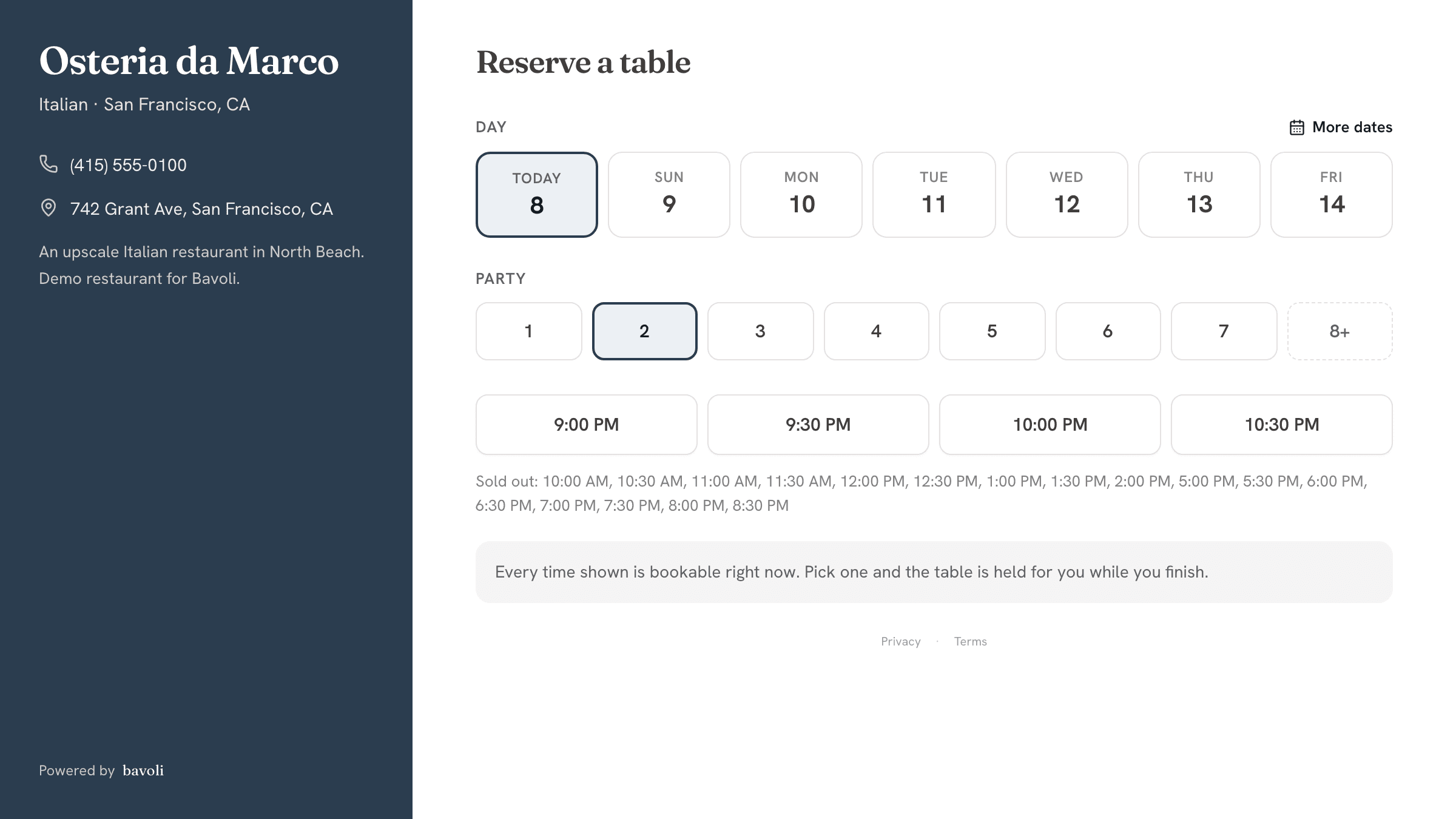
The best OpenTable alternative for most independent restaurants in 2026 is bavoli, because it is free: $0 a month with $0.00 in per-cover fees, no contract, and every feature included. If you want a recognizable diner network, Resy is the strongest brand-name option. If you already run Toast for your POS, Toast Tables is the path of least resistance.
How it works
Compare all five
Real prices, honest pros and cons, and the catch for each system. Ranked for independent restaurants.
Try free, no card
bavoli is $0/mo. Unlimited reservations, floor plans, and no-show protection with no credit card.
Go live in an afternoon
Add your tables, set your hours, share the booking link. Keep the notebook as backup for one week.
Quick answer: the 5 best OpenTable alternatives
Short on time? Here is the ranked list with the entry price each provider charges as of June 2026. Per-cover fees, where they exist, are on top of the monthly number.
- 1. bavoli: best for independent restaurants that want predictable cost. $0/mo, every feature included. $0.00 per-cover, always.
- 2. Resy: best for restaurants that want a well-known diner network. From $249/mo (Amex-owned).
- 3. Toast Tables: best if you already run Toast for your POS. $50/mo plus POS processing (2.49% + $0.15 per transaction).
- 4. Yelp Guest Manager: best if Yelp is already your main discovery channel. From $159/mo.
- 5. Eat App: best for multi-location groups that want a free starting tier. $0/$99/$199/$389 per month tiers.
bavoli versus OpenTable, in plain numbers
Annualize it and the gap stops being an argument about philosophy. OpenTable's entry point is $299/mo before a single cover fee. Add the network charge of roughly $1 per seated cover and a modest 400-cover month lands near $700. Over twelve months that is well past $8,000, and it is the good years that cost the most.
bavoli is $0 across that same year, at any volume. The per-cover fee is $0.00 at 400 covers, at 1,400 covers, or on a Valentine's Day that turns the room three times, and there is no monthly fee underneath it.
| Covers in a month | OpenTable Core, network bookings | bavoli |
|---|---|---|
| 100 covers | About $399 ($299 plus roughly $100 in cover fees) | $0 |
| 400 covers | About $699 ($299 plus roughly $400 in cover fees) | $0 |
| 1,000 covers | About $1,299 ($299 plus roughly $1,000 in cover fees) | $0 |
What you get, free
Flat pricing, no per-cover fees
$0.00 per cover and $0 a month. Your busiest month costs the same as your slowest.
Your data stays yours
Guest profiles and reservation history belong to you rather than the platform. Export anytime.
No contract, cancel anytime
No contract and no monthly fee. No annual commitment, no card to start, no surprise charges.
Free forever
$0/mo with no end date: unlimited reservations, floor plans, guest profiles, no-show protection, and a waitlist.
Why OpenTable rarely fits a small restaurant
The ranking above is mostly a pricing argument, and it lands hardest on small rooms, so it is worth saying plainly why. OpenTable was designed around a diner network and around the restaurants big enough to pay for access to it. That can genuinely make sense for a 200-seat destination fighting for visibility in a crowded market. For an independent room that already has regulars, a neighborhood, and a Google listing that works, you are often paying a network premium for diners you would have gotten anyway.
The other half of the problem is structure rather than sticker price. The subscription and the per-cover charge listed at the top of this page stack on each other, and the per-cover line is the unpredictable one: the busier you get, the more you owe. That is backwards from how a small operation wants its software to behave, because the month you most need cash is the month the bill grows. Contracts are typically annual as well, so a slow February does not shrink the commitment you signed in October.
What "free" actually means here
Two of the five options above advertise a free option, so it is worth being precise about the word, because plenty of tools that rank for it are running a countdown. You hand over a card, the clock starts, and 14 or 30 days later you are paying. bavoli is $0 a month with no end date and no card on file, and you can run real reservations on it for as long as you want.
There is no second tier hiding behind it. Reservations, the waitlist, floor plans, guest profiles, SMS, the phone agent, and online ordering are all included. The only charges anywhere in bavoli are per-order fees on online ordering, 50c per pickup order, $1 per delivery order, and 0.5% on dine-in QR orders, and those only exist if you turn ordering on. Nothing shuts off mid-service and nothing bills you on its own.
1. bavoli: best for independent restaurants that want predictable cost
bavoli is built specifically for independent restaurants, including ones with no reservation system at all. It is free: $0 a month, every feature included, and there are no per-cover or per-reservation fees, it's $0.00 always, with no contract and no card to sign up.
Everything is included: unlimited reservations, floor plans, staff accounts, guest profiles, a waitlist with SMS, no-show protection, analytics, menus, an AI phone agent, and online ordering. The only charges anywhere in bavoli are per-order fees on online ordering, 50c per pickup order, $1 per delivery order, and 0.5% on dine-in QR orders, which your guest covers at checkout by default.
bavoli is $0 a month with $0.00 per-cover fees. In exchange you keep full ownership of your guest data and you can export it any time.
- Pros: $0 a month with $0.00 per-cover fees; every feature included; no card to sign up; you own and can export your guest data; no contract.
- Cons: no built-in consumer discovery network like OpenTable's; POS integration and multi-location support are not available yet; smaller brand recognition with diners.
2. Resy: best for the diner network
Resy, owned by American Express, carries real weight with diners in major metros and is a credible choice if a recognizable booking network matters to your concept. Its tiers run $249, $399, and $899 per month as of June 2026, with no per-cover fee on the base structure.
The trade-off is cost and ownership. Entry pricing starts at $249/mo, far above a flat independent tool, and as with most network platforms your guest relationship is mediated by the network. For a high-demand restaurant chasing reach, that can be worth it. For a neighborhood room watching every dollar, it's a lot.
- Pros: strong consumer brand and demand in big cities; Amex backing; no per-cover fee on the core tiers.
- Cons: starts at $249/mo; oriented toward higher-volume, brand-driven restaurants; less of a fit for a single independent room on a tight budget.
3. Toast Tables: best if you already run Toast
If your POS is already Toast, Toast Tables is the lowest-friction add-on. It's $50/mo and plugs directly into the Toast ecosystem you already use for ordering and payments.
The catch is the payment processing. Toast's POS fees of 2.49% + $0.15 per transaction apply to your sales, so the $50/mo reservations line is only part of the real cost. It's a strong pick if you're already inside Toast and a weaker one if you'd be adopting the whole POS just to get reservations.
- Pros: $50/mo flat for the reservations module; tight integration if you already run Toast POS.
- Cons: POS processing fees (2.49% + $0.15) apply to sales; mainly makes sense if you're already a Toast customer.
4. Yelp Guest Manager: best if Yelp is your channel
Yelp Guest Manager starts at $159/mo and is most compelling if Yelp is already where your diners find you. Bookings flow from your Yelp listing, which can be meaningful for restaurants that lean on Yelp for discovery.
If Yelp isn't a major source of your covers, the $159/mo entry price buys reach you may not use. It's a channel decision more than a pure software decision.
- Pros: bookings tied directly to your Yelp listing; useful if Yelp drives your discovery.
- Cons: $159/mo entry price; value is concentrated for restaurants already reliant on Yelp.
5. Eat App: best free-tier alternative for groups
Eat App offers a tiered structure of $0, $99, $199, and $389 per month billed monthly (about 30% less on annual billing), so like bavoli it has a free entry point and no per-cover fee. It leans toward restaurant groups and is positioned for multi-location operators who want to scale within one tool.
For a single independent room, Eat App's prices climb quickly once you outgrow the free entry point. It's a reasonable alternative to compare directly, especially if you're evaluating multiple locations.
- Pros: free starting tier; no per-cover fee; built with multi-location groups in mind.
- Cons: Eat App's tiers reach $389/mo billed monthly; feature depth is gated behind higher tiers for smaller rooms.
Switching, choosing, and what free really means
Frequently asked questions
Keep reading
More honest comparisons and pricing breakdowns for independent restaurants.
- See the full bavoli vs OpenTable comparison
- Compare bavoli vs Resy pricing and features
- How bavoli compares to Toast Tables
- bavoli vs Yelp Guest Manager side by side
- bavoli vs Eat App for independent restaurants
- What bavoli costs: nothing, except per-order fees on online ordering
- Compare bavoli against every major reservation system
- Free restaurant reservation software, compared for 2026
- Cheap restaurant reservation software at $0/mo
- A free restaurant waitlist app for walk-ins and the door